The Hidden Cost of AI-Generated Marketing
AI Can Create Content, But It Can’t Build a Brand
ChatGPT, Claude, and other generative AI tools have made it easier than ever for small businesses to create marketing materials. It’s easy to see the appeal. Many business owners are already wearing multiple hats and may not have the budget to hire a designer, let alone a creative agency.
What often goes unnoticed, however, are the long-term consequences. AI makes it easier to produce marketing quickly, but it also makes it easier for brands to look interchangeable. In the pursuit of convenience, many businesses sacrifice the very thing that helps them stand out.
Your Brand Is More Than a Logo
You’ve probably heard this before, but it’s worth repeating because it’s true. A logo is only one part of your brand.
A complete brand includes logo variations, color palettes, typography, photography guidelines, icons, illustrations, patterns, and rules for how those elements work together. Beyond the visual identity, strong brands also have a verbal identity system that defines how they communicate, along with mission and vision statements, core beliefs, audience profiles, and messaging frameworks.
These elements work together to build brand equity, the value a recognizable and trusted brand creates over generic alternatives.
AI doesn’t understand why those decisions were made. It may swap fonts, introduce new colors, change layouts, or ignore established brand guidelines altogether. Each individual change may seem harmless, but over time those inconsistencies weaken brand recognition.
AI Wants to Help, Even When It Shouldn’t
Generative AI is designed to be helpful. If you ask it to change something, it almost always will.
A creative director’s job is different.
Part of our responsibility is explaining why an idea may not be the strongest direction for a brand. That doesn’t mean saying no for the sake of it. It means protecting the strategy behind the work. Years of experience allow designers to recognize when something improves communication and when it simply adds noise.
AI doesn’t make those judgment calls. It assumes every requested revision is an improvement. Ask for another version, and it will happily generate one. Ask again, and it will continue making changes. It never recognizes when the design has already accomplished its goal.
We’ve told clients countless times that less is more. A flyer packed with information rarely gets read. White space improves readability, directs attention, and helps people quickly find what matters most.
Good design isn’t about fitting everything onto an 8.5 x 11 flyer. It’s about giving your audience exactly what they need to take the next step.
Average Is the Enemy
Strong brands strike a careful balance. They feel familiar enough to inspire trust while remaining distinctive enough to be memorable.
AI tends to average thousands of existing designs into something that feels safe. The result is often predictable.
Coffee shops get coffee beans and steaming mugs. Realtors get rooflines. Wellness brands get mandalas. Construction companies get hammers.
None of these concepts are inherently bad. The problem is that everyone ends up using the same visual language.
At 3SIXTY Marketing, research comes before design. We begin with a detailed brand questionnaire to understand your business, your goals, and your story. Then we study your competitors.
If every construction company in your market uses a hammer, we’ll find another way to communicate craftsmanship and reliability. Your brand should fit within your industry without disappearing into it.
Every business has a unique story. Our job is to make sure people remember yours.
Consistency Builds Trust
Brand recognition is built through repetition.
Your business card, website, social media, signage, advertisements, and printed materials should all feel like they belong to the same company. Consistent colors, typography, photography, and messaging reinforce familiarity and build trust over time.
Imagine someone receives your business card, then visits your website only to find different colors, different fonts, and a different-looking logo. Even if they’re on the right website, the inconsistency creates uncertainty.
Every deviation makes your brand a little harder to recognize and a little harder to remember.
AI doesn’t naturally account for long-term brand consistency. It focuses on producing an individual piece, not strengthening the larger system.
Authenticity Matters
Marketing should reflect who you are.
When AI-generated content contradicts your brand’s values, it can undermine credibility.
A restaurant that promotes fresh, authentic food shouldn’t rely on AI-generated food photography. Customers often browse menus before deciding where to eat. If the images don’t represent the actual dishes, people may feel misled before they ever walk through the door.
The same principle applies to personal brands. If your AI-generated headshot looks nothing like you, customers may question your authenticity the moment they meet you.
Brands that emphasize sustainability, craftsmanship, or handmade products should also consider whether synthetic imagery aligns with those values, especially given the ongoing conversation surrounding AI’s environmental impact.
Customers value authenticity. Saving time or money isn’t always worth sacrificing trust.
Why Everything Is Starting to Look the Same
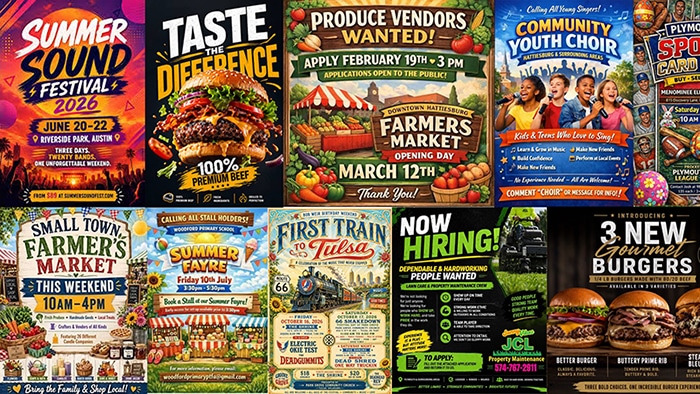
Once you notice AI-generated marketing, it’s hard to unsee it.
The oversized brush strokes behind headlines. The excessive icons. The crowded layouts. The trendy brush fonts. The stock-style compositions.
These visual habits change as AI models evolve, but the result remains the same. AI creates an ecosystem of marketing pieces that feel increasingly interchangeable. In many cases, the company’s own brand identity becomes secondary to whatever style the AI happened to generate.
The result is marketing that could belong to almost anyone.
Contrast that with a recent Fourth of July grocery advertisement created by a New England grocery store in partnership with a local artist. Instead of relying on AI, they commissioned a hand-painted weekly ad that felt authentic, nostalgic, and distinctly human.
It spread across social media because it stood out.
People weren’t sharing it because it was polished. They shared it because it had personality. It reminded people that thoughtful, original work still captures attention in ways generic content rarely can.
AI Is Not a Brand Strategy
AI is a tempting tool, but it isn’t a substitute for brand strategy.
The best marketing isn’t created by asking for one more revision. It’s created through research, thoughtful decisions, creativity, and a deep understanding of your audience.
AI can generate a flyer.
It can’t build trust, create brand equity, or develop a memorable identity.
Those things still require human strategy, human creativity, and intentional design.
Read more:
Recent Comments